



Welcome to Earth and Life Institute
The Earth and Life Institute (ELI) is a research institute from UCLouvain that gathers more than 450 scientists, covering a wide range of disciplines in the Earth and life sciences.
The aim of their research is to study and understand, at different scales, the fundamental physical, chemical and biological processes that govern the functioning of our planet, in order to develop sustainable solutions to some of the major challenges faced by our societies.
5 research departments
Upcoming events

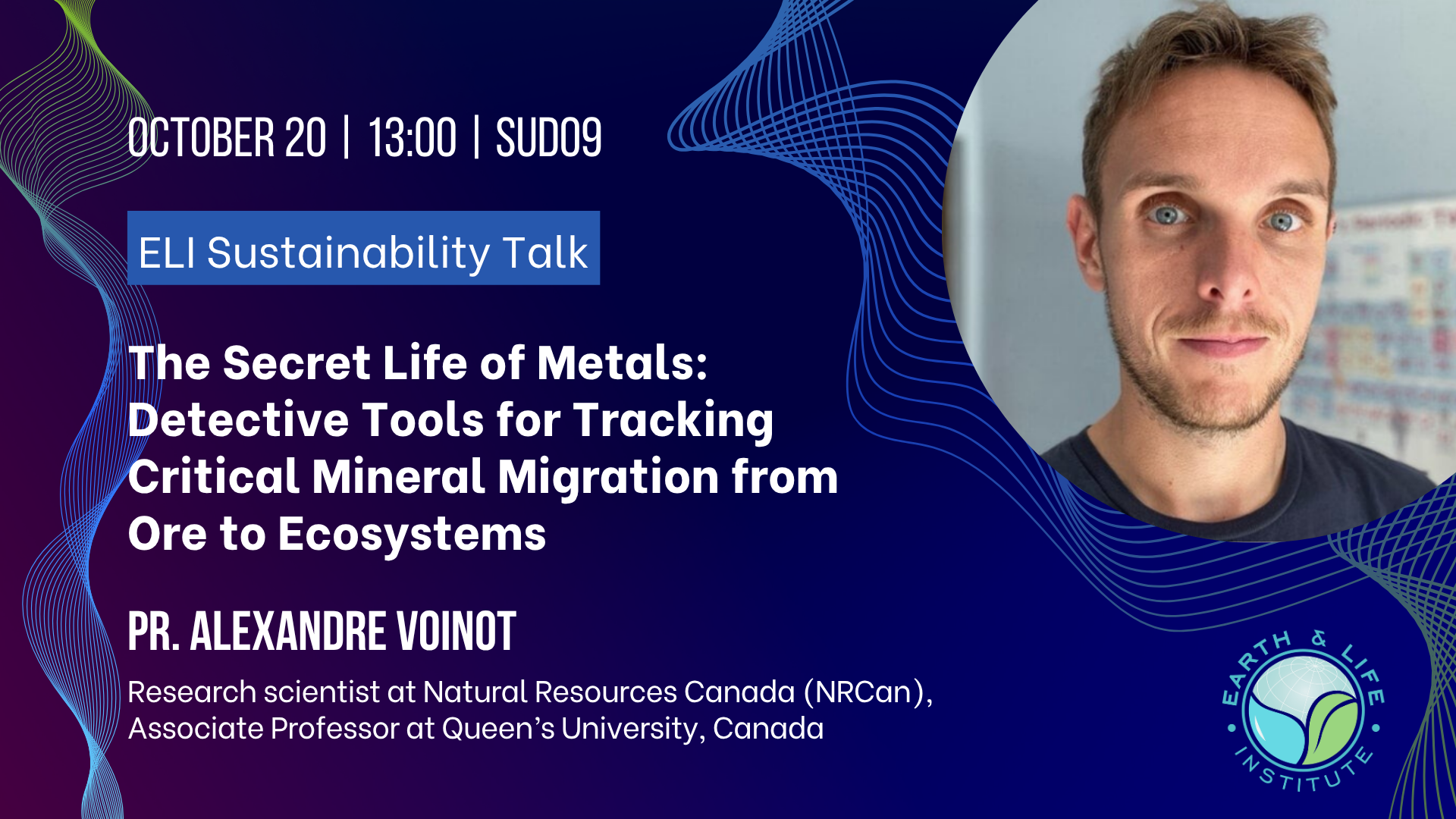
ELI-T: The secret life of metals: Detective tools for tracking critical mineral migration from ore to ecosystems
On October 20, the Earth and Life Institute is pleased to welcome Dr. Alexandre Voinot for a new ELI-Sustainability Talk, followed by a panel discussion.
Abstract
ELI-T seminar: The Secret Life of Metals: Detective Tools for Tracking Critical Mineral Migration from Ore to Ecosystems
Multi-scale approaches (from the ore body to the surface, via the various mineral phases) and multi-technique approaches (isotopes, laser ablation, biogeochemistry, eDNA).
Panel discussion: Designing the next generation of metal tracking in response to the critical mineral rush
How should we approach the issue of changes in resource management and exploration, and how can our respective scientific disciplines address the issues and challenges this raises? A discussion of the various potential avenues for interdisciplinary research relevant to this issue.
The guest
Dr. Alexandre Voinot is a research scientist at Natural Resources Canada (NRCan), and Associate Professor at Queen’s University, Canada.
He's a geochemist specializing in biogeochemistry and metal mobility.
His work as a research scientist focuses on a multidisciplinary innovative approach to answering key geoscience question, such as mineral ore deposit processes or the mobility of metals in the surficial environment.
He specializes in using isotopic proxies (B, Li, Mo, Tl...) combined with innovative methods like metagenomics to study the role of microorganisms in remobilization processes or machine-learning and artificial intelligence techniques for large-scale mineral prospectivity or environmental baseline mapping.
His expertise extends to the development and optimization of purification and measurement methods for various isotope systems, complemented by proficiency in operating advanced analytical instruments such as HR, MC, and Quad-ICPMS, as well as laser ablation units.
Beyond research, his scientific journey has seen him mentor and guide many students (undergraduate and graduate) as well as HQPs. His teaching methodologies are based on hands-on and field-based experimentation, and he aims to instill a deep-seated passion for scientific inquiry in the next generation of scientists.
Practical
When: October 20
- Lunch: 12:15 - 12:55
- Talk: 13:00 - 13:50
- Panel discussion: 14:00 - 15:00
Where: Place Croix du Sud, Louvain-la-Neuve, Belgium
- Lunch: SUD09 hall
- Talk: SUD09 auditorium
- Panel discussion: Ocean room (B.002), de Serres building
Follow the ELI-T seminar online here.
Follow the panel discussion online here.
For who: Open to everyone.
Price: Free, but mandatory registration for the lunch.
Registration: Register here by 13 October at the latest if you want to attend the lunch. Registration is mandatory for the lunch. Registration for the talk and/or panel discussion only is appreciated but not mandatory.


-
 22 June 202620% of car-commuting UCLouvain staff could shift to cyclingCycling uptake isn't about bike lanes alone — it only occurs when at least 3 of 4 conditions are met at once. Applied to UCLouvain staff, this pinpoints a concrete, named group: 20.5% of car commuters could realistically switch to cycling — a real target for policy, as opposed to a vague aspiration.


